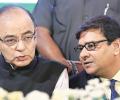
Patel, who headed the RBI from September 2016 till his sudden resignation in December 2018, says in his book thta the government seemed to lose enthusiasm for the new bankruptcy law in the middle of the year he left the central bank. Though Patel does not name anybody in the book, the mid-2018 period he refers to is the time when Piyush Goyal held temporary charge of the finance ministry between May and August.

India is the largest importer of gold after China.

Giving more freedom to individuals travelling abroad, they may soon be allowed to spend $2 lakh overseas in a year as against the present ceiling of $75,000.

The finance ministry is not only keen to split the roles of CMD, but also wants to appoint them for a fixed tenure of five years.

They expressed concern on taxation issues, the high fiscal and current account deficits, and sought removal of capital gains tax.

India's economic growth rate is expected to be at least 6 per cent in the 2013-14 fiscal, Prime Minister's Economic Advisory Council (PMEAC) Chairman C Rangarajan said.

The Supreme Court on Wednesday allowed banks and financial institutions to provide services related to cryptocurrencies by setting aside the RBI's 2018 circular which had prohibited them. A three-judge bench, headed by Justice R F Nariman, said the Reserve Bank of India circular is liable to be set aside on the ground of "proportionality". "Accordingly, the writ petitions are allowed and the circular dated April 6, 2018 is set aside," said the bench, also comprising justices Aniruddha Bose and V Ramasubramanian.

"We firmly hold that undermining the central bank is a recipe for disaster and government must desist," All India Reserve Bank Association said in a letter. The association said Acharya's comments about the government's interventionist role vis-a-vis the RBI has created a flutter across the nation. "This is, however, not a sudden outburst, but was waiting to happen due to long simmering discontent," the association said.
The idea is to boost household savings and turn more of them into growth capital. If the plan succeeds, sustained eight per cent-plus rates of gross domestic product growth should be within reach in a few years.

The Finance Audit and Investment committee recommended 8.95% interest.

The 47th GST Council meeting that is currently underway is slated to discuss a host of issues, including a mechanism for compensating states for revenue loss, tax rate tweaks in some items and relaxed registration norms for small online suppliers. Further, the meeting of the Council, chaired by the Union Finance Minister Nirmala Sitharaman and comprising state counterparts, will also clear levying the highest tax of 28 per cent on online games, casinos and horse racing, besides, measures to curb tax evasion, especially devising ways to tackle high-risk taxpayers in GST. "The meeting is being chaired by Hon'ble Union Minister of Finance @nsitharaman and many important decisions are expected to be taken at the meet," PIB Chandigarh tweeted.

A long crisis with a lack of sound short-term, long-term actions can result in sluggish growth in India, similar to that in Japan.

The Reserve Bank on Tuesday asked all lending institutions, including non-banking financial companies, to implement the waiver of interest on interest for loans up to Rs 2 crore for the six months moratorium period beginning March 1, 2020.

Now that the economy is growing at a higher-than-expected rate, it is time to accelerate the pace of fiscal consolidation, and the Budget could be a good starting point, argues Rajesh Kumar.

The friction with the political class is not only about interest rates and monetary policy. While the government often spoke freely about its discomfiture, the RBI had to be careful even in its response to the government as any loose statement would affect the markets.

A government panel said policymakers and regulators should have an open mind regarding the introduction of an official digital currency in India.

It has been a year since the Reserve Bank of India (RBI) initiated prompt corrective action (PCA), an exercise that puts weak banks under central bank scrutiny, against the 94-year-old Lakshmi Vilas Bank (LVB). But recently, this low-profile Chennai-headquartered bank found itself attracting some unwonted publicity when 60 per cent of its shareholders voted against a proposal to re-appoint seven directors, including one of the promoters, K R Pradeep (who holds around 2 per cent), and the company's managing director & chief executive officer S Sundar.

Moody's assumes that the RBI will continue to pursue price and financial stability and implement policies towards these goals.

Arvind Subramanian was appointed CEA in October 2014 and got a year's extension in September 2017

The Bharatiya Janata Party regime will have to make good on this election slogan to restore state-owned banks to health, says Rajiv Lall.

The IMF expressed its opposition to any move that compromises the independence of central banks anywhere in the world.

The finance ministry said the sharp inflows last fiscal were due to the government's policy initiatives and economic recovery.
.jpg)
2014 made a lot of promises; can the new year deliver?

Government is framing a rule that will make it compulsory for regulators like Sebi, Irdai and PFRDA to deposit a significant portion of their reserves into the Consolidated Fund of India.

Public sector banks are inefficient, poorly governed and beset by largescale corruption.

In a message to public sector banks (PSBs) that only performers will survive, the government, in an unprecedented move, has decided to allocate capital to only nine PSBs.

The appointment will be made by Prime Minister Narendra Modi in consultation with Finance Minister Arun Jaitley.
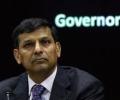
Experts applaud RBI governor RAghuram Rajan for his good work.

Chief Economic Advisor (CEA) V Anantha Nageswaran on Thursday said describing India's recovery as 'K-shaped' was wrong as both rural and urban economies were recovering, albeit at different paces. Speaking to reporters at the Finance Ministry, Nageswaran said the gross domestic product (GDP) growth print for the recent October-December quarter (Q3FY23) will likely be revised upwards. "The notion of using the letter 'K' to denote urban and rural is somewhat wrong because it is almost as if one is growing and one is contracting. "I would say one segment's slope is more positive, and the other one slope is less positive but it is positive," Nageswaran said.
The modus operandi highlighted by CBI says that while the corporate strikes a deal for imports with a company in one country, the billing is done at inflated prices in other country by the group's front company.
The windfall from RBI may be used to trim borrowing, help fund Rs 3.3 lakh crore capex plan, capitalise banks and provide fiscal stimulus to some stressed sectors, experts and economists said.

The first high-level meeting of the Special Investigation Team on the issue of black money and special probe into cases of unaccounted funds stashed away abroad by Indians has been advanced and will now be held on June 2.

Unlike any other business, banking is a turf where the captain's role is the most critical. Often a bank is defined by the personality of the CEO who runs it. Both HDFC Bank and Kotak Mahindra Bank are the creation of their CEOs, notes Tamal Bandyopadhyay.

Arundhati Bhattacharya is a strong contender for chairperson post, after Pratip Chaudhuri retires in September.
The government has asked the Indian Banks' Association to make sure that IDBI Bank's wages are on a par with other banks.

While presenting her 2021-22 Union Budget, Finance Minister Nirmala Sitharaman had set a fiscal deficit target of 6.8 per cent of nominal gross domestic product (GDP) against the 2020-21 Revised Estimate of 9.5 per cent. The fiscal correction in the upcoming 2022-23 Union Budget is unlikely to be that steep. Even as discussions among top Budget-makers are ongoing, the fiscal deficit target for 2022-23 may likely be in the range of 6.5-6.8 per cent.

'The no-rate cut policy and preference to wait for the Budget and clarity on the fiscal front demonstrate RBI Governor Shaktikanta Das is maturing in his new role,' notes Tamal Bandyopadhyay.
Besides advancing the presentation of the Budget to perhaps the first week of January, , there are four new initiatives that could be rolled out from the next Budget, says A K Bhattacharya.

RBI governor Raghuram Rajan is likely to cut rates in next monetary policy.
 © 2026 Rediff.com - Advertise with us - Disclaimer - Privacy Policy - Sitemap - Feedback - About us - Terms of use - Grievances